Training at KinEthic Safety
Build a safety culture where care, accountability,
and performance reinforce each other.
We provide end-to-end health and safety
training – from leadership and systems to frontline skills – focused on behavior-based performance improvement and management engagement. Each course is designed
to help you move beyond compliance to sustained excellence.
Training Formats: On-site, office-based, virtual, blended
Languages: English, Latvian
Customization: Sector-specific modules (construction, manufacturing, logistics, utilities, energy, chemicals)

Training Catalog
1 Health & Safety Management for Senior Managers
Audience: Board members, executives, directors
Duration: 1 day (with optional 2-hour executive clinic)
Overview: Strategic governance of H&S with board-level accountability, personal KPIs, and culture leadership.
Learning Outcomes:
Build and own an H&S strategy aligned with business goals.
Set meaningful executive KPIs and lead by example
Understand legal duties and reputational risk
Value Proposition: Elevates H&S from compliance to competitive advantage and resilience.
KPIs:
Leading: % executives with H&S KPIs; board safety walkabouts/month; % leadership participation in investigations
Lagging: Lost Time Injury Frequency Rate (LTIFR); % actions closed from board reviews
2 Health & Safety Management for Frontline Managers
Audience: Supervisors, site managers, team leads
Duration: 4 to 8 hours (length and content is a subject for adjustment)
Overview: Practical management of daily H&S, coaching behaviors, and closing the loop on corrective actions.
Learning Outcomes:
Conduct effective toolbox talks & safety observations
Manage permits, controls, and contractor activities
Use PDCA in daily operations
Value Proposition: Turns supervisors into safety coaches, improving consistency and trust.
KPIs:
Leading: quality coaching observations/week; % toolbox talks with behavioral content; action closure time
Lagging: Minor injury rate; repeat non-conformities per quarter
3 Hazard Identification, Risk Assessment & Risk Management
Audience: All employees; safety reps; engineers
Duration: 4–6 hours
Overview: Practical hazard spotting, risk evaluation, and control selection (HIRARC).
Learning Outcomes:
Apply hierarchy of controls and risk matrices
Identify critical risks and safeguards
Document and communicate controls clearly
Value Proposition: Reduces blind spots and normalization of deviance.
KPIs:
Leading: # hazards identified/100 employees; % high-risk tasks with verified controls; % updated risk registers
Lagging: Severity-weighted incident rate; # high-potential near misses
4 Behavior-Based Safety (BBS)
Audience: All levels; change agents; H&S champions
Duration: 1 day + 6-week coaching cycle
Overview: Systematic observation, feedback, and reinforcement of safe behaviors.
Learning Outcomes:
Run observation programs and positive reinforcement
Design behavioral checklists and coaching scripts
Analyze behavioral data and remove barriers
Value Proposition: Sustainable improvement through habits, not paperwork.
KPIs:
Leading: # BBS observations/week; % safe behaviors; % positive feedback ratio
Lagging: Trend of recordable incidents linked to at-risk behaviors
5 Fire Safety & Evacuation Drills
Audience: All employees; wardens; facility managers
Duration: 3–4 hours + practical drill
Overview: Prevention, detection, response, evacuation, and post-drill review.
Learning Outcomes:
Use extinguishers and alarms appropriately
Plan evacuation routes and assembly points
Conduct post-drill debriefs and improvements
Value Proposition: Faster, safer evacuations and reduced fire risk.
KPIs:
Leading: Drill participation rate; average evacuation time; % corrective actions from drills closed
Lagging: # fire-related incidents; property damage costs trend
6 Permit to Work (PTW) System
Audience: Permit issuers, receivers, supervisors, engineers
Duration: 1 day
Overview: Safe control of high-risk work (confined space, hot work, LOTO, work at height).
Learning Outcomes:
Define roles/responsibilities and approvals
Verify isolations and controls; manage conflicts
Audit PTW quality and close-out
Value Proposition: Prevents catastrophic events by tightening control on critical tasks.
KPIs:
Leading: % high-risk tasks under PTW; PTW audit score; % permits with documented isolations
Lagging: # PTW violations; high-potential incidents linked to PTW
7 Reporting of Accidents, Near Misses & Safety Concerns
Audience: All employees; H&S teams; managers
Duration: 3 hours
Overview: Build an open reporting culture, with simple, non-punitive processes.
Learning Outcomes:
Distinguish events; foster safe behavior
Escalate effectively and anonymize where needed
Analyze trends and communicate learnings
Value Proposition: Better foresight and fewer repeats.
KPIs:
Leading: Reporting rate/100 employees; % near misses vs accidents; average time to triage
Lagging: Recurrence rate of similar incidents; investigation cycle time
8 Leadership in Health & Safety Culture (advanced executive edition)
Audience: CEOs, board members, senior leadership teams
Duration: Half day + coaching
Overview: Culture diagnostics, leadership behaviors, shaping narratives and incentives.
Learning Outcomes:
Diagnose culture maturity; set culture KPIs
Align incentives with safety behaviors
Communicate authentically (care + accountability)
Value Proposition: Culture change starts at the top—and sticks.
KPIs:
Leading: % leadership engagement actions completed; safety climate survey score; # safety storytelling sessions
Lagging: Culture-related incident themes reduced quarter-on-quarter
9 Incident Investigation & Root Cause Analysis
Audience: H&S professionals, managers, team leads
Duration: 1 day
Overview: Techniques (5 Whys, Fishbone, TapRooT-style thinking), barrier analysis, corrective action quality.
Learning Outcomes:
Identify systemic and behavioral root causes
Develop effective corrective/preventive actions (CAPA)
Track effectiveness and learning transfer
Value Proposition: Stops treating symptoms—fixes systems.
KPIs:
Leading: % investigations completed on time; CAPA quality score; % effectiveness reviews completed
Lagging: Repeat incident rate; reduction in same-cause incidents
10 Emergency Preparedness & Crisis Management
Audience: Crisis teams, facility leaders, ERTs, communications
Duration: 1 day + tabletop exercise
Overview: Scenario planning, command structure, communications, business continuity.
Learning Outcomes:
Build and test emergency plans
Run tabletop scenarios and after-action reviews
Integrate with external agencies
Value Proposition: Faster recovery, lower impact, stronger stakeholder confidence.
KPIs:
Leading: # exercises/year; average time to activate crisis team; % corrective actions closed
Lagging: MTTR (mean time to recovery); incident consequence severity trend
11 Contractor & Supplier Safety Management
Audience: Procurement, project managers, site managers
Duration: 1 day
Overview: Prequalification, onboarding, supervision, performance reviews, shared responsibility.
Learning Outcomes:
Define minimum H&S requirements in contracts
Run joint risk assessments and toolbox talks
Measure and improve contractor performance
Value Proposition: Prevents outsourcing of risk; drives consistent standards.
KPIs:
Leading: % contractors prequalified for H&S; onboarding completion rate; joint inspection frequency
Lagging: Contractor incident rate vs internal baseline; % non-conformities per contractor
12 Ergonomics & Workplace Wellbeing
Audience: Office staff, operators, HR, H&S reps
Duration: 3–4 hours
Overview: Practical ergonomics, MSD prevention, fatigue, mental health basics.
Learning Outcomes:
Optimize workstations and manual handling
Identify early MSD warning signs
Promote wellbeing and recovery practices
Value Proposition: Fewer injuries, better energy, higher productivity.
KPIs:
Leading: % ergonomic assessments completed; # workstation adjustments; wellbeing participation rate
Lagging: MSD claim rate; absenteeism related to MSD/stress
13 Safe Work at Heights
Audience: Construction, maintenance, facility teams
Duration: 1 day + practical
Overview: Fall protection, equipment inspection, rescue plans.
Learning Outcomes:
Select and inspect fall protection systems
Plan and supervise safe access
Execute rescue drills
Value Proposition: Prevents high-severity incidents and stoppages.
KPIs:
Leading: % height work under approved method statements; equipment inspection pass rate; rescue drills/year
Lagging: Fall-from-height incident rate; severity index
14 Lockout/Tagout (LOTO) Procedures
Audience: Maintenance, engineering, operations
Duration: 4 hours + practical
Overview: Control of hazardous energy—electrical, mechanical, pneumatic, hydraulic, chemical, thermal.
Learning Outcomes:
Develop and follow LOTO procedures
Verify zero-energy state
Audit LOTO compliance
Value Proposition: Prevents severe injuries during servicing.
KPIs:
Leading: % tasks under LOTO; audit score; LOTO training refreshers completed
Lagging: Energy-release incidents; repeat findings in audits
15 Machine Safety & Guarding
Audience: Production managers, maintenance, H\&S
Duration: 1 day
Overview: Guarding principles, interlocks, risk reduction for machinery.
Learning Outcomes:
Assess machine hazards and safeguards
Implement inspections and stop-work triggers
Manage modifications safely
Value Proposition: Protects people and uptime.
KPIs:
Leading: % machines meeting guarding standards; inspection frequency; % corrective actions closed
Lagging: Machine-related injury rate; unplanned downtime from safety breaches
16 Chemical Safety & Hazardous Materials
Audience: Lab staff, manufacturing, warehouse, EHS teams
Duration: 1 day
Overview: Classification, labeling (GHS), SDS interpretation, storage, spill response.
Learning Outcomes:
Read SDS and implement controls
Store and segregate chemicals correctly
Respond to spills safely
Value Proposition: Lower exposure risk and regulatory issues.
KPIs:
Leading: % chemicals correctly labeled; SDS accessibility rate; # spill drills/year
Lagging: Exposure incidents; environmental release events
17 Psychological Safety & Stress Management
Audience: Managers, HR, teams
Duration: 4 hours
Overview: Create environments where people speak up; manage stress and workload risk factors.
Learning Outcomes:
Facilitate open dialogue and learning behaviors
Identify psychosocial risks early
Implement supportive practices and referral pathways
Value Proposition: Better decision-making, fewer surprises, higher engagement.
KPIs:
Leading: Psychological safety survey score; speak-up interventions; EAP/peer support utilization
Lagging: Turnover in high-risk teams; stress-related absence rate
How We Deliver – Methodology
Plan: Diagnose current state (data review, interviews, observations), define objectives and KPIs.
Do: Training delivery, practical exercises, leadership engagement, BBS deployment.
Check: Measure leading and lagging indicators, run after-action reviews, share insights.
Act: Close gaps, coach leaders, refine processes, scale what works.

Results You Can Expect
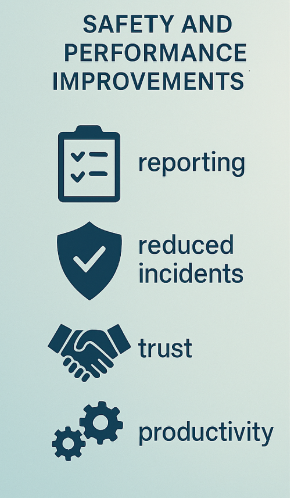
Increased reporting and learning (near misses, observations, actions closed)
Reduced incident frequency and severity
Stronger leadership credibility and employee trust
Improved contractor performance and standardization
Tangible ROI through fewer stoppages and better productivity